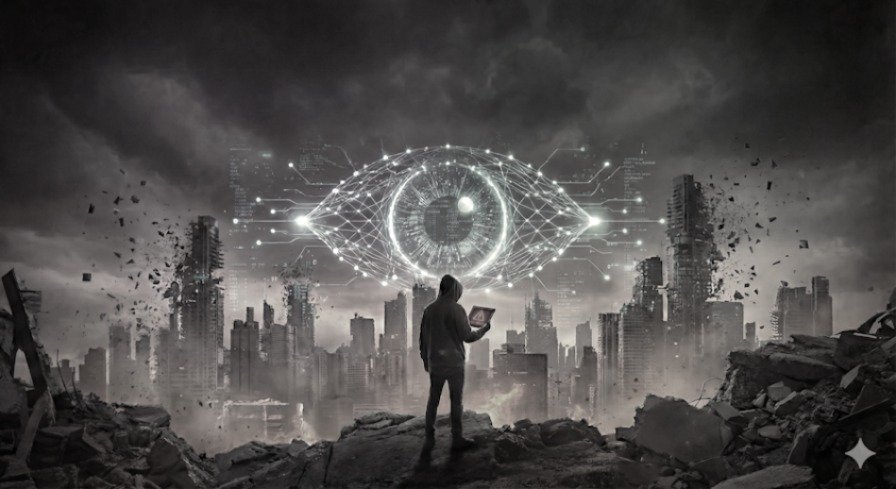
The World That Did Not End
The World That Did Not End is currently in active development, with the first book — The Last Normal Days — on track for completion by mid-summer 2026. Set against the backdrop of an America on the edge of something it doesn’t yet have words for, the story follows a cast of unforgettable characters — a Texas rancher wrestling with a faith he’s never truly tested, a brilliant MIT-trained coder building the very system she fears, a skeptical journalist chasing a story that keeps getting bigger than the story, a battle-worn pastor haunted by a war he thought he’d left behind, and a woman who sees what no one else is willing to name — as the infrastructure of a new world quietly clicks into place around them. While the full manuscript moves toward completion, this page will be updated regularly with scenes, character stories, and pages pulled directly from the draft — raw glimpses into the people and events at the heart of the series. Consider it an open window into a story still being written, for readers who want to be the first ones in.
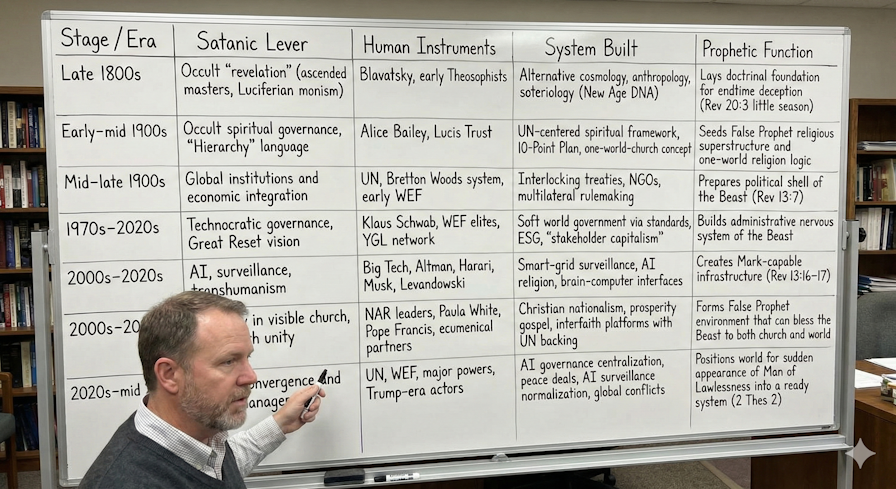
Possible narrative paragraphs where Pastor Michael Croft walks Sarah Mitchell through the steps on how Satan influenced society:
Pastor Michael Croft took a deep breath and drew the tip of his pen down the whiteboard, carving history into seven neat segments.
“Look at it this way,” he said. “Satan doesn’t improvise. He builds in phases—like a man assembling a machine he won’t actually sit in until it’s finished.”
He wrote at the top: Phase I – The Blueprint.
“Late nineteenth century,” Pastor Michael continued. “The age of steam and steel, but also of séances and parlors thick with cigar smoke and spirits. That’s when a Russian mystic named Helena Blavatsky steps onto the stage. She isn’t just dabbling in occult parlor tricks. She gives the West a new story about reality itself.”
He tapped the first heading. “Blavatsky replaces the Creator with an impersonal cosmos, replaces Adam with root races, replaces repentance with evolution into godhood, and dares to call Lucifer the bringer of light instead of the enemy of souls. The important thing for you to see is this: she doesn’t overthrow Christianity head on. She builds a middle world—spiritual, mystical, global—where people can be ‘deep’ and ‘enlightened’ without ever bowing to Christ.”
He wrote underneath: Phase II – Institutionalization.
“Next,” Pastor Michael said, “the blueprint gets an office and a letterhead. In the early twentieth century, Alice Bailey takes Blavatsky’s raw occult material and turns it into a program. A ‘Plan.’ Suddenly the gods become a ‘Hierarchy,’ the demons become ‘Masters,’ and the loose ideas harden into a spiritual strategy for a new world order.”
He drew a box and wrote: UN / Lucis Trust. “The same current flows right into the architecture of global governance. You have a publishing house openly tied to Luciferian teaching, quietly repositioned and plugged into the wiring of the United Nations. Now Satan’s occult story isn’t just in books. It’s sitting in prayer rooms, think tanks, advisory councils. The machine has a frame.”
He moved down and marked: Phase III – Technocratic Beast.
“The mid to late twentieth century?” Pastor Michael’s voice softened. “That’s when the frame is wrapped in circuits. Global institutions standardize money, trade, law. Then the World Economic Forum arrives with a smile and a slogan: we’re just coordinating the future. Their Young Global Leaders graduate straight into parliaments, cabinets, central banks. On paper, it’s cooperation. In the shadows, it’s convergence.”
He circled the word technocracy. “The Beast doesn’t need fangs at first. It only needs dashboards and levers. Algorithms decide credit, travel, visibility, employment. Surveillance installs itself in cameras, phones, and networks. The world slowly accepts the idea that a panel of untouchable experts should manage every crisis. That’s the skeleton the Man of Lawlessness will one day inhabit.”
He added another heading: Phase IV – Transhuman Promise.
“Then comes the seduction of godhood in a lab coat,” Pastor Michael said. “Blavatsky told men they were evolving into gods through hidden wisdom. Now the same lie wears a hoodie and talks about code. Historians and technologists promise Homo Deus—humanity upgraded, consciousness merged with machines, death postponed, limits erased. AI stops being a tool and starts to sound like an oracle, a confessor, a judge. Some even speak of it as a coming god.”
He turned back to the board. “By this point, the Beast system can do something no empire ever could: it can know you, score you, include or exclude you, in real time. All it needs is a signal of allegiance and a point of contact—hand, forehead, implant, device. The mark is no longer distant symbolism; it’s a menu option waiting for the right crisis.”
He drew a line down the other side of the board and titled it: Religious Capture.
“Remember, though,” Pastor Michael said, “the Beast needs a chaplain. The system is built, but people still need blessing. So in the Church, something else is happening. Movements arise that talk about taking the ‘seven mountains’ of culture—government, media, business—for God. The words sound holy. The method is pure empire: seize the top and rule downward.”
He let that hang, then added, “They wrap political power in prophetic language. A leader isn’t just a president anymore; he’s anointed. Opposition isn’t disagreement; it’s demonic. Miraculous language and spiritual theatrics gather around earthly power, preparing the imagination of believers to accept a ruler who promises safety, greatness, and victory—if they will only trust him without question.”
Beneath that he wrote: Interfaith Universalism.
“Outside the evangelical world,” Pastor Michael went on, “a different melody plays the same song. Ancient churches, global councils, and international agencies begin to sing about one human family, one shared spirituality, one common destiny. The sharp edges of the gospel—one Lord, one Name, one cross—are sanded down. What matters now is harmony, fraternity, the survival of the planet.”
He underlined the word oneness. “Do you see it? Theosophy’s dream of a single spiritual canopy over all religions starts to look righteous. A universal faith for a universal order. When the Beast finally appears, he will not have to invent a one world religion; it will simply recognize him as its missing center.”
Pastor Michael stepped back so the whole board was visible: occult blueprint, global institutions, technocratic control, transhuman promise, captured churches, interfaith canopy—each box feeding the next.
“This,” he said quietly, “is how Satan works during the Little Season. Not with random explosions, but with a long, patient architecture. He binds Blavatsky’s visions to Bailey’s plans, ties them into the United Nations, overlays them with Davos and AI, baptizes politics with counterfeit prophets, and crowns it all with a gentle, smiling religion of universal brotherhood.”
He turned to the protagonist, eyes searching.
“And somewhere near the end of that process, a man steps onto the stage—a single human face for a system that’s already in place. He will not look like a cartoon villain. He will look like the fulfillment of every promise this machine has been whispering for a century: peace, progress, security, transcendence. The question isn’t whether the structure will exist when he comes.”
Pastor Michael tapped the board one last time. “The question is whether the saints will recognize the machine before they recognize the man.”